
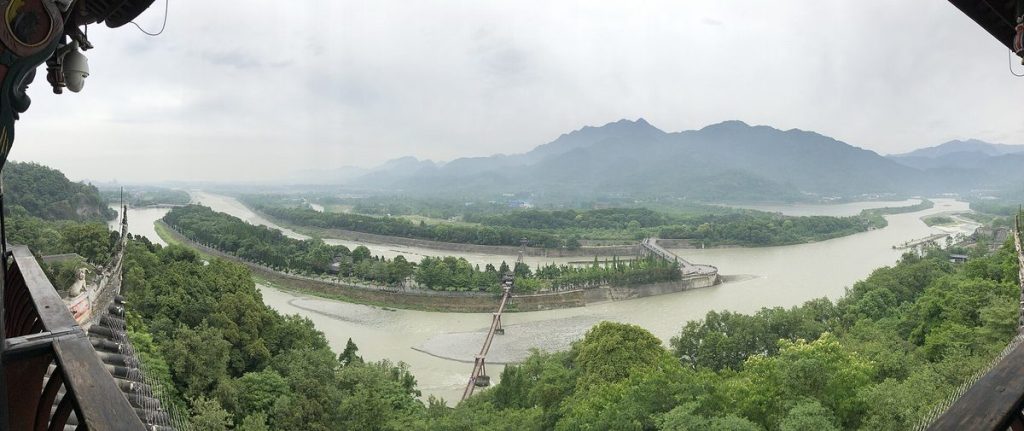
Just fifty kilometers northwest of Chengdu, the bustling capital of Sichuan Province, lie two of China’s most profound historical and spiritual treasures: the ancient Dujiangyan Irrigation System and the mist-shrouded green peaks of Mount Qingcheng. Together, they represent a harmonious balance of ancient engineering genius and natural Taoist tranquility, designated as a joint UNESCO World Heritage site.
Built in 256 BC without a single concrete dam wall, Dujiangyan is the oldest functioning water conservation engineering project on earth, transforming the flood-prone Chengdu Basin into the fertile “Land of Abundance” (Tiānfǔ Zhī Guó, 天府之国). Directly adjacent stands Mount Qingcheng, revered as one of the four sacred birthplaces of religious Taoism. With frequent intercity bullet trains connecting downtown Chengdu in under thirty minutes, visiting both landmarks on an independent day trip is one of the premier day excursions in southwestern China.
Quick Takeaways: Dujiangyan & Qingcheng Day Trip
1. How to Get There: The Xipu Cross-Platform Transit Secret
The fastest and most affordable way to reach Dujiangyan and Mount Qingcheng from Chengdu is via the Chengdu-Dujiangyan Intercity Railway (C-trains, Chéng-Dū Chéngjì Tiělù).
Rather than departing from congested central train stations, head to Xipu Railway Station (犀浦站), located on the northwestern edge of Chengdu:
The Same-Platform Cross Transfer: Xipu is famous in Chinese railway engineering as the nation’s first cross-platform intermodal transit hub. Take Chengdu Metro Line 2 directly to its western terminus at Xipu Station. When you step off the subway train onto the elevated platform, the high-speed bullet train track sits on the exact opposite side of the same island platform. Simply scan your passport at the mid-platform ticket transfer gates without exiting the station.
Frequency and Travel Time: C-trains depart Xipu every 15 to 30 minutes throughout the day. The journey to Lidui Park Station (Líduī Gōngyuán, 离堆公园站—the closest station to Dujiangyan’s main entrance) takes just 20 minutes and costs 10 RMB ($1.40 USD). Continuing past Dujiangyan to Qingchengshan Station (Qīngchéngshān, 青城山站) takes an additional 10 minutes (15 RMB total).
Book your C-train tickets in advance on 12306 or Trip.com, as morning weekend departures frequently sell out to domestic day-trippers.
2. Morning: Unlocking the Genius of Dujiangyan
Arrive at Dujiangyan Scenic Area (Dūjiāngyàn Fēngjǐngqū, 都江堰景区) by 8:30 AM to beat tour group crowds. Entering through the South Gate brings you directly onto the ancient waterways that tamed the raging Min River (Mín Jiāng), a turbulent glacial tributary descending from the Tibetan Plateau.
In 256 BC, Qin State Governor Li Bing (Lǐ Bīng, 李冰) and his son devised an ingenious eco-engineering design that controlled catastrophic flooding and routed irrigation water without erecting a blocking dam. Follow the paved pedestrian path to observe the three foundational components of the system:
1. Fish Mouth Water-Dividing Levee (鱼嘴, Yúzuǐ): An elongated artificial stone levee shaped like a fish’s snout built in the middle of the river. It naturally cleaves the Min River into an Inner Channel (Nèijiāng) and an Outer Channel (Wàijiāng). During dry spring seasons, the levee’s hydrodynamic curve automatically channels 60% of river flow into the Inner Channel for crop irrigation. During torrential summer flood stages, river levels rise and automatically divert 60% of excess floodwaters back into the main Outer Channel to prevent valley devastation.
2. Flying Sand Spillway (飞沙堰, Fēishāyàn): A low spillway weir that harnesses centrifugal water vortices. When floodwaters curve past the levee, swirling river currents automatically eject 85% of heavy gravel and river silt over the weir into the outer river, preventing the irrigation channels from silting up.
3. Bottle-Neck Channel (宝瓶口, Bǎopíngkǒu): A deep, narrow gorge carved straight through the solid limestone ridge of Yulei Mountain using ancient thermal shock techniques (heating rocks with fire and cracking them with cold water). The gorge acts as a natural gatekeeper, restricting water volume entering the Chengdu Plain to prevent flooding while maintaining constant irrigation pressure.
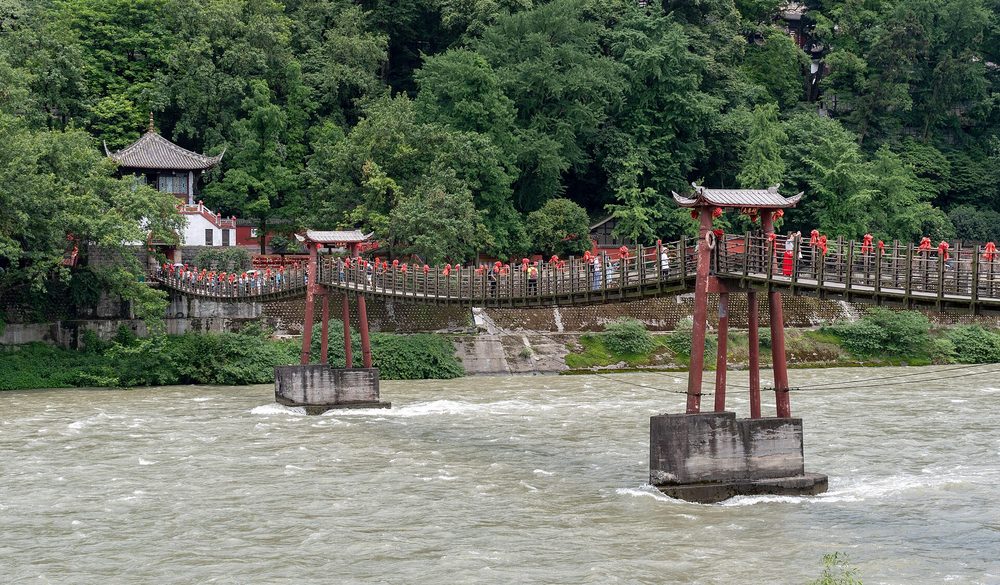
Cross the swaying 320-meter Anlan Suspension Bridge (Ānlán Suǒqiáo, 安澜索桥) spanning the roaring river, and climb the stone hillside steps to Erwang Temple (Èrwáng Miào, 二王庙), a tiered wooden shrine honoring Li Bing and his son with panoramic viewpoints overlooking the entire waterworks.
3. Afternoon: Exploring Sacred Mount Qingcheng (Front Mountain)
After a quick local lunch of Dujiangyan cold noodles or river dumplings outside the scenic gate, take a 15-minute taxi or Didi ride (approx. 20–25 RMB) south to Mount Qingcheng Front Mountain (Qīngchéngshān Qiánshān, 青城山前山).
Mount Qingcheng is famously celebrated in Chinese poetry with the phrase “Qingcheng Mountain is the Most Tranquil Under Heaven” (Qīngchéng Tiānxià Yōu, 青城天下幽). It is blanketed in ancient subtropical evergreen forests, weeping cedar trees, bamboo groves, and moss-covered timber pavilions. In the second century AD, Taoist master Zhang Daoling founded the Celestial Masters school of religious Taoism on these slopes.
To experience the mountain efficiently in four hours:
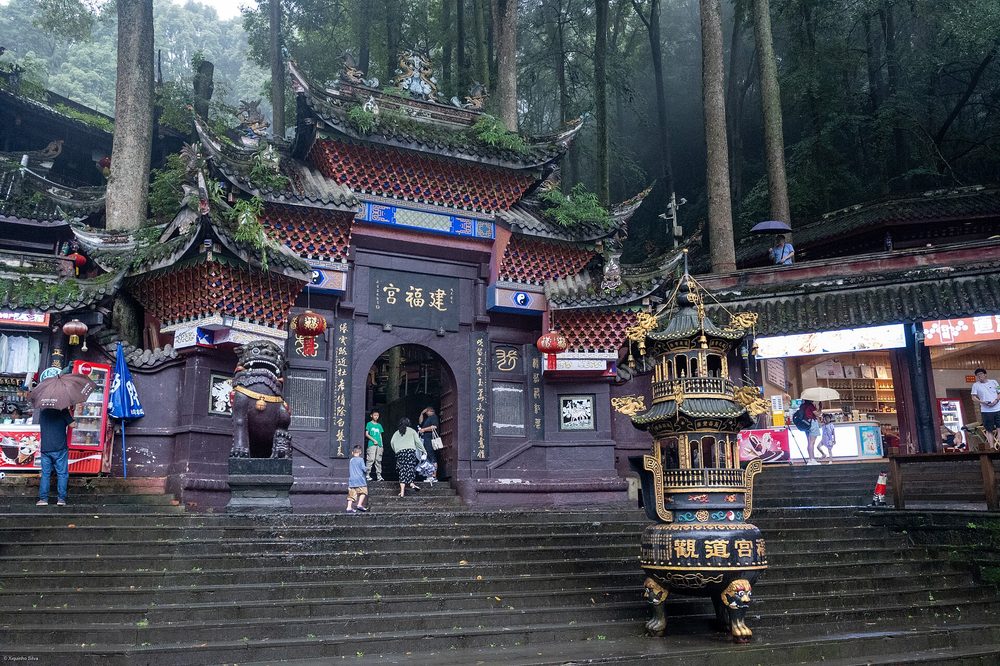
Step 1: Jianfu Palace to Yuecheng Lake. Pass through the main wooden gateway and pay respects at Jianfu Palace (建福宫), an active Taoist sanctuary surrounded by bonsai gardens. Walk 15 minutes along shaded stone paths beside tumbling forest streams to emerald Yuecheng Lake (月城湖).
Step 2: Lake Ferry and Cable Car. Board a quiet electric wooden ferry across the small lake (5 RMB, 3 minutes). Step directly from the boat dock onto the base terminal of the Qingcheng Cable Car (Qīngchéng Suǒdào). The enclosed gondola glides above deep forested ravines for ten minutes up to the mountain shoulder (35 RMB one-way, 60 RMB round-trip), bypassing two hours of strenuous vertical stone climbing.
Step 3: Shangqing Palace and Laojun Pavilion. From the upper cable car station, hike 20 minutes up shaded stone stairways to Shangqing Palace (上清宫, Shàngqīng Gōng), a sacred Daoist monastery featuring calligraphic inscriptions by celebrated Chinese painter Zhang Daqian, who resided here in the 1940s. Ascend the final steps to Laojun Pavilion (Lǎojūn Gé, 老君阁), a towering multi-tiered pagoda crowning the 1,260-meter summit. On clear days, the viewing deck commands vistas stretching from snowcapped Tibetan peaks in the west to the emerald Chengdu Plain in the east.
Step 4: The Descent. Take the cable car back down to Yuecheng Lake and enjoy the tranquil downhill forest walk back to the main entrance by 17:30.
4. Front Mountain vs. Back Mountain: Which Should You Choose?
First-time visitors often wonder whether to visit Front Mountain (Qiánshān) or Back Mountain (Hòushān):
• Front Mountain (前山): 80 RMB admission. Contains all the famous historical Taoist temples, cultural shrines, paved walking paths, cable cars, and summit pavilions. Choose Front Mountain for a classic day trip combining culture, heritage, and history.
• Back Mountain (后山): 20 RMB admission. Located further west, Back Mountain contains virtually no ancient temples. Instead, it is an outdoor wilderness hiking route featuring wooden boardwalks suspended over dramatic river canyons, waterfalls, and mist-filled gorges. Hiking Back Mountain requires a full dedicated 6-to-8-hour day and is best suited for avid trail hikers staying overnight in rural Qingcheng guesthouses.
5. Returning to Chengdu for Evening Hotpot
From the Mount Qingcheng Front Mountain parking plaza, catch a quick 5-minute taxi or local shuttle bus (5 RMB) to Qingchengshan Railway Station. Board an evening C-train back to Xipu Station or direct to Chengdu Railway Station in 30 minutes.
You will arrive back in downtown Chengdu by 19:00—just in time to wash off trail dust and celebrate a day of ancient engineering and mountain tranquility with a bubbling feast of authentic Sichuan hotpot or Kung Pao chicken in the bustling alleys of Kuanzhai Xiangzi.