
Entering China has become significantly more streamlined for international travelers. With the broad expansion of unilateral visa exemptions, the 144-hour and 240-hour visa-free transit policies, and modernized digital airport terminals, foreign visitors can enter China without complex paperwork. This authoritative guide details entry policies, border clearance procedures, arrival card completion, and customs regulations.
Quick Summary: Essential China Entry Rules
1. China Unilateral Visa-Free Policy
China provides unilateral visa-free entry for ordinary passport holders from dozens of partner countries for tourism, business visits, family reunions, and transit stays. Travelers from eligible nations do not need an invitation letter or prior embassy appointment.
- Eligible Nations: Citizens holding ordinary passports of France, Germany, Italy, the Netherlands, Spain, Switzerland, Ireland, Hungary, Austria, Belgium, Luxembourg, Poland, Portugal, Greece, Cyprus, Slovenia, Slovakia, Norway, Finland, Denmark, Iceland, Andorra, Monaco, Liechtenstein, Australia, New Zealand, South Korea, Singapore, Malaysia, and Thailand, among others.
- Authorized Length of Stay: Generally up to 15 or 30 days per entry depending on mutual bilateral agreements and current official National Immigration Administration notices.
- Entry Requirements: An ordinary passport with at least six months of remaining validity, confirmed onward travel tickets departing China within the permitted period, and hotel reservations or local host contact details.
- Multiple Entries: Travelers may enter multiple times under this policy throughout the year, provided each stay strictly abides by the duration limit and remains genuine tourism or short-term business.
2. 144-Hour & 240-Hour Transit Without Visa (TWOV)
If your passport issuing country is not on the unilateral exemption list (such as the United States, United Kingdom, Canada, or Japan), you can use the 144-Hour or 240-Hour Visa-Free Transit Policy when traveling through mainland China to a third country or region.
The Third-Country Routing Requirement
Your journey must strictly follow an Origin A → Mainland China → Destination B route, where Origin A and Destination B are distinct countries or administrative regions. Hong Kong, Macau, and Taiwan count as separate third destinations. Round-trip routes (such as London → Beijing → London or Los Angeles → Shanghai → Los Angeles) do not qualify.
Regional Movement Clusters
Transit travelers must remain within authorized geographic clusters. Common clusters include Beijing-Tianjin-Hebei, Yangtze River Delta (Shanghai, Jiangsu, Zhejiang), Guangdong Province (Greater Bay Area), and Sichuan Province (Chengdu area). Leaving your permitted cluster without prior immigration endorsement is prohibited.
3. Step-by-Step Airport Border Clearance
International airports across China operate modern immigration terminals. Follow this sequence upon arrival at gateway hubs like Beijing Capital (PEK), Beijing Daxing (PKX), Shanghai Pudong (PVG), Guangzhou Baiyun (CAN), or Chengdu Tianfu (TFU):
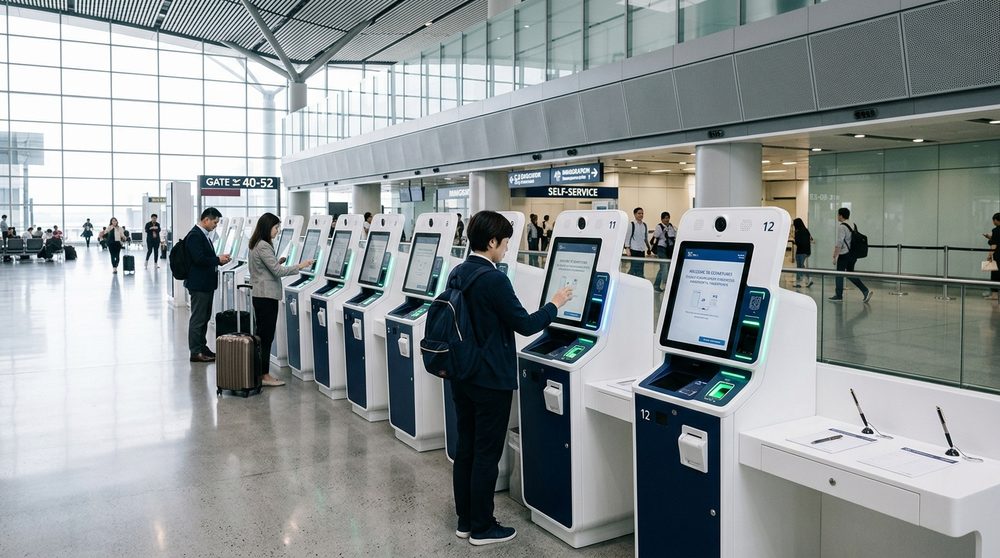
- Biometric Fingerprint Kiosks: Prior to border inspection counters, step up to the automated self-service kiosks. Select your language, scan your passport photo page, and place your four left fingers followed by four right fingers on the optical scanner. The machine prints a small confirmation slip confirming your biometric capture. Travelers under age 14 and over age 70 are exempt.
- Complete the Physical Arrival Card (入境卡, Rùjìng Kǎ): Fill out the blue-and-white card distributed on your flight or available at writing stands in the arrival concourse. Write clearly in English block letters: your full name, passport number, date of birth, flight number, contact telephone number, and the exact street address or hotel name in China. Having your hotel reservation saved on your phone in Chinese characters ensures seamless completion.
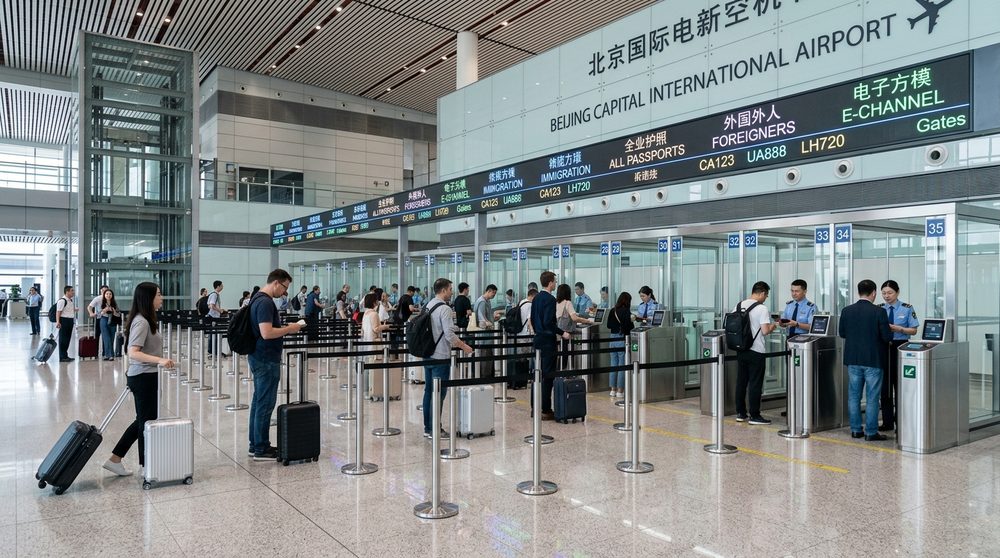
- Border Inspection Counter: Join the lane marked “Foreign Passengers” (外国人). If applying for a 144-hour or 240-hour transit stay, look for the specialized “Transit Visa Exemption” counters. Present your passport, incoming boarding pass, completed arrival card, confirmed onward flight ticket showing your departure to a third country, and biometric slip. The officer inspects your documents, captures a digital facial photo, stamps your passport, and returns your documents.
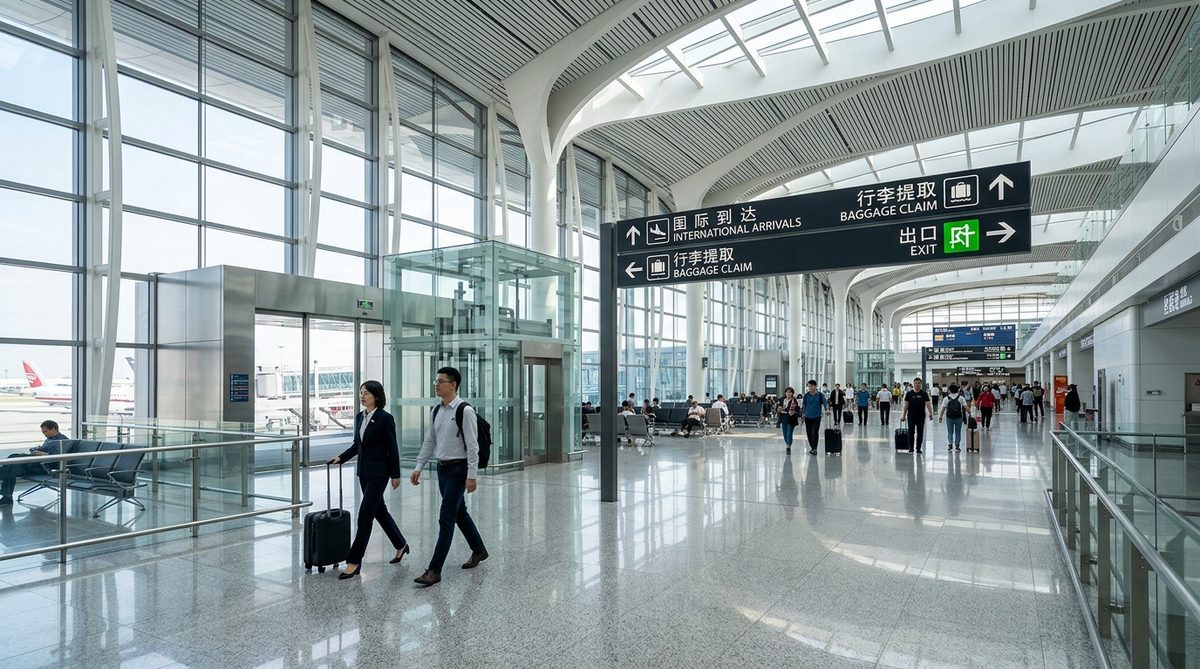
- Baggage Claim: Follow illuminated bilingual overhead signage to the assigned carousel. Free luggage carts are available throughout the baggage concourse.
- Customs Inspection (海关, Hǎiguān): Walk through the Green “Nothing to Declare” aisle if all items in your baggage fall within personal duty-free allowances. Enter the Red Channel if you carry commercial goods, restricted samples, or currency exceeding declaration thresholds.
4. Customs Allowances, Prohibited Goods & Aviation Rules
China Customs enforces standard international border regulations. Knowing personal duty-free limits and aviation safety rules prevents delays or property confiscation:
- Currency Declaration Thresholds: You may bring in foreign currencies without limit. However, carrying cash exceeding the equivalent of $5,000 USD or more than 20,000 RMB requires a written declaration at the Red Customs Channel.
- Tobacco and Alcohol: Duty-free allowances permit up to 400 cigarettes (two cartons) and up to 1.5 liters of alcoholic beverages with an alcohol content exceeding 12 percent.
- Lithium Power Banks (Strict Aviation Rule): Power banks must be carried in your cabin baggage only; they are strictly forbidden in checked luggage. The capacity must not exceed 100Wh (approx. 27,000mAh at 3.7V). Power banks between 100Wh and 160Wh require airline counter approval. Any unit exceeding 160Wh, or any power bank without clear manufacturer rating text on the casing, will be confiscated at airport security checkpoints.
- Drones & Aerial Equipment: Personal camera drones (such as DJI models) are permitted for personal tourism. However, civilian drones weighing over 250 grams must be registered on the Civil Aviation Administration of China (CAAC) UOM online portal. Strictly avoid operating drones near airports, government compounds, or sensitive national borders.
- Prohibited Inbound Agricultural Items: Fresh fruits, vegetables, raw or cooked meat products, poultry, egg products, live plants, soil, and biological specimens are strictly banned to prevent agricultural contamination.
5. Pre-Departure Digital Setup for Smooth Travel
Modern daily life and urban transit in China operate entirely through digital platforms. Setting up your smartphone apps before leaving home eliminates initial friction upon landing:
- Configure Alipay & WeChat Pay: Link your international Visa, Mastercard, or debit card to both apps. This enables cashless purchases at restaurants, convenience stores, convenience markets, and metro turnstiles nationwide. For full configuration steps, consult our detailed Foreigner Payment Guide.
- Verify Passport on Railway 12306: Download the official bilingual 12306 rail app. Submit your passport details for identity verification 48 hours prior to travel so you can book high-speed rail tickets instantly at official prices. See our step-by-step 12306 Bullet Train Booking Guide.
- Set Up an International eSIM: Installing an international travel eSIM prior to departure routes your data through roaming networks, providing seamless connectivity to essential messaging, web searching, and travel utilities from the moment your plane lands.
- Save Offline Chinese Addresses: Hotel staff and taxi dispatch desks rely on Chinese character addresses. Save screenshots of your hotel names and addresses in Chinese characters (汉字) on your phone camera roll to show taxi drivers and information counters.
Essential China Logistics & City Exploration Guides
- How to Use Alipay and WeChat Pay: Complete Cashless Guide
- How to Book China High-Speed Trains: 12306 App & Station Navigation
- Beijing Travel Guide: Great Wall, Forbidden City & Essential Tips
- Shanghai Travel Guide: Modern Skylines, Food & Water Towns
- Explore All 34 China Destinations by Province & City